Geocoding prices in 2026

Here’s a clear overview of what the main geocoding services cost in 2026, and whether anything changed recently. Use the table and the interactive chart below to compare prices at a glance and to simulate your costs. 🙂
Table of contents:
Pricing overview
Roughly what you pay after the free tier (per 1,000 requests, in USD). Free tiers and volume discounts vary; check each provider for exact terms.
| Provider | Free tier | Price per 1,000 (after free) | Note |
|---|---|---|---|
| Google Maps | 10,000/month | $5.00 | Volume discounts; see March 2025 changes below. |
| HERE | 30,000/month | $0.83 | Volume discounts; 6% increase from April 2026 for new contracts and renewals. |
| TomTom | 2,500/day (~75k/month) | $0.75 | Volume discounts. |
| Mapbox (Temporary) | 100,000/month | $0.75 | Temporary results only; no long-term storage. |
| Mapbox (Permanent) | — | $5.00 | Allows indefinite storage of results. |
| OpenCage | 2,500/day (~75k/month) | from ~$0.15–0.17 | Subscription-based; volume discounts. Permissive storage. |
| Nominatim (OSM) | Public API rate-limited | Free | Self-hosting has infra costs. |
Many countries also have free or low-cost official APIs (e.g. France's BAN, Spain's CartoCiudad, UK's OS Places under certain schemes). For local addresses, check our country-specific comparisons linked at the end.
Compare costs at your volume
The difficulty is that most providers have different pricing tiers and different free tiers. So you need to know exactly how many addresses you need to geocode to know which provider is the cheapest. Also, prices typically decrease as volume increases, so your per-request cost depends heavily on your total usage.
You can simulate your costs with the interactive chart below. Just select the number of addresses you need to geocode and the chart will show you the cost per provider!
Did prices change?
Google (March 2025): Google replaced the previous $200/month credit with per-SKU free usage (e.g. around 10,000 free billable events per month for the Geocoding API). Volume discount tiers were expanded for high usage. So the effective free tier for geocoding is lower than before, but heavy users can see lower marginal costs at scale. Details: Google Maps Geocoding API guide and Google Maps Platform March 2025 changes.
HERE (April 2026): From April 1, 2026, the HERE Base Plan and all pay-per-transaction Location Services and Data IO increase by 6% for new contracts, renewals, and extensions. Existing contracts are unchanged until renewal. See HERE price increase by 6% in 2026 for details.
Other major providers: TomTom, Mapbox, and OpenCage have kept their published pricing stable into 2026. Our source dates in the repo are October 2025 / January 2026; always confirm current prices on each provider’s site before committing.
How to reduce geocoding cost
Relying on a single premium provider (e.g. Google at $5 per 1,000 requests) can become very expensive at scale. A proven way to cut costs without sacrificing quality is cascading geocoders: use several providers in a defined order, and only fall back to the next when the current one fails or does not meet your criteria.
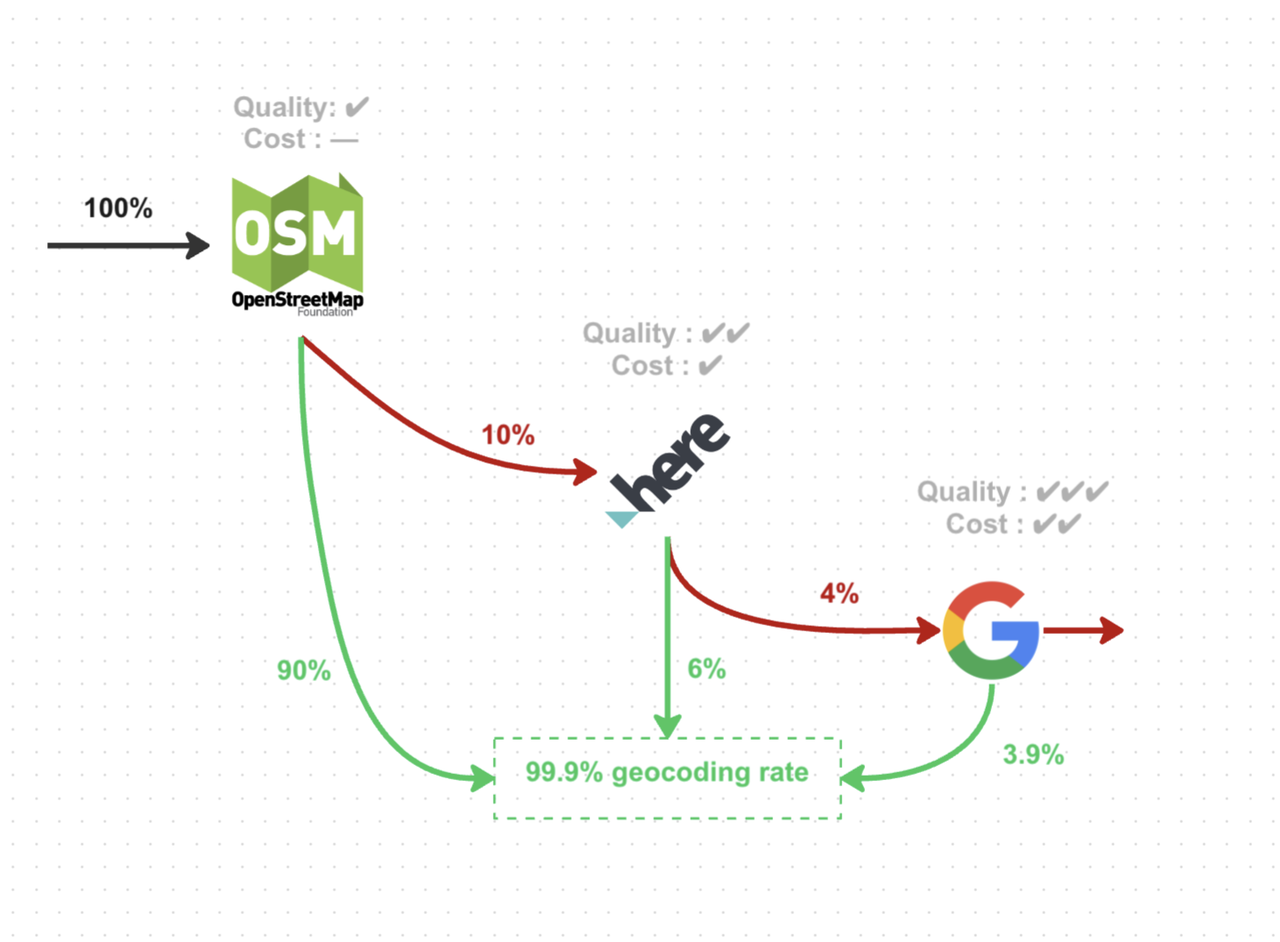
What is cascading? You define an ordered list of providers (e.g. OpenStreetMap or OpenCage → HERE → Google). For each address, you try the first provider; if that fails or the result does not pass validation, you automatically try the next one, and so on. Cheaper or free providers handle the bulk of easy addresses; premium providers are used only for the harder cases. The result: higher success rates (often 98–99% instead of ~90% with one provider) and lower total cost, because most requests are served by the least expensive option.
Reduce your costs with Coordable cascading geocoding
The diagram below illustrates the idea: send 100% of requests to a free or low-cost provider first (e.g. OSM); only the unresolved share (e.g. 10%) goes to a mid-tier provider (e.g. HERE); and only the remainder (e.g. 4%) hits the premium provider (e.g. Google). You still reach a very high overall geocoding rate (e.g. 99.9%) while paying the premium rate for a small fraction of traffic.
You can implement cascading in your own code (call provider A, then B on failure, etc.) or do it easily with Coordable: choose your providers, define the cascade order and fallback rules, and optionally validate results so only good coordinates reach your database. Either way, the principle is the same: prioritize cheaper solutions and only fall back to premium when it is truly necessary.
Try Coordable to easily implement cascading geocoding for your business.
Price is not everything
Pricing does not always reflect quality. The cheapest option is not necessarily the worst, and some geocoders can match or beat large commercial providers depending on region and data type (addresses vs POIs, local vs global). To see how providers actually perform where you operate, check the best geocoding provider for your country. We have in-depth comparisons for:
- Best geocoding providers for France
- Best geocoding providers for Germany
- Best geocoding providers for Italy
- Best geocoding providers for Luxembourg
- Best geocoding providers for Portugal
- Best geocoding providers for Spain
- Best geocoding providers for the United Kingdom
Where to go from here
For more detail on a single provider (coverage, rate limits, licensing), see our guides: Google Maps Geocoding API, HERE Geocoding API, Mapbox Geocoding API. For a head-to-head in 2026, see Google vs HERE for geocoding.